Showing posts with label quotations. Show all posts

Thursday, May 14, 2009

No-cello practice

When I first became an over-the-top obsessively-committed beginning cello player, I bought a Prakticello so that wherever I went, for business or vacation, I could take my cello along to practice while I was away from home. There was no way I was going to backslide because I couldn't practice with no cello available. I became quite good at setting it up and breaking it down, and it provided endless fascination for TSA checkers. But I gradually came to resent the extra hassle of flying with it, and finally, when DH and I were living in separate cities for awhile, I left it set up at "his place," and used it for practice while I was there. That was (so far) it's last trip, as when I moved out to join him I broke it down, packed it in its box, and stashed it in a corner of the new house. I know it's there if I need it.

As a more experienced intermediate-level cello player who still travels fairly often, I have gained confidence that I won't lose all of my hard-won skills and revert back to the beginning if I don't play the cello for a few days. But practicing is part of my life, something I do, and am, and I practice every day, whether I have a cello available or not.

I don't mean to write an exhaustive treatise on no-cello practice, but thought I'd list the things I brought along on my current trip, by way of answering Ten Northern's question, "What do you mean by 'no-cello practice'?".

1. String quartet by Alexander Glasunov, op. 26. I'm not actually playing this, but a friend asked me for some fingering recommendations, if I had time. Marking a part with fingerings and bowings is a great thing to do when traveling. This quartet has lots of little chromatic puzzles to work out those fingerboard geography muscles.

2. Brahms sonata no. 1 in e. I am preparing the first movement to play for T4- at my lesson in 2.5 weeks.In addition to marking fingerings, I'll totally mark this part up for memorizing, with bowings on almost every change and fingerings at the beginning of phrases in addition to on the shifts, where I usually mark them. That's so I can start anywhere on the right bow and finger when I am practicing tiny bits at a time, later. I will also survey the movement for structure and work out which parts are alike, and how the alike parts are different. Then I'll start memorizing it by singing it.

3. Duport #7. I have already re-written this etude as chords, changing it from it's written-out arpeggios into something I can see the structure of more clearly. With this, I'll mentally practice chord changes as coordinated movements. I find this quite fatiguing, so I'll only do a few measures at a time.

4. A chair. OK, I didn't bring that with me, but plan to use one here in the room. I'll tip it back toward me as I sit in another chair and practice one of my new motor skills. My directive is to develop more flexibility in my thumb mcp (left hand), particularly in thumb position. So I will pretend I have a fingerboard, and with thumb and one finger at a time observe what I need to do to vibrate with a flexible hand while keeping equal weight between thumb and finger. This is also something you can do with arm cello, but since I have a wooden chair handy I thought I'd use that instead.

I also have two books with me: Mastery: The Keys to Success and Long-Term Fulfillment, by George Leonard and Set Your Voice Free: How To Get The Singing Or Speaking Voice You Want, by Roger Love.

Here's a quote from this morning's reading from Leonard's book to inspire you:
...the essence of boredom is to be found in the obsessive search for novelty. Satisfaction lies in mindful repetition, the discovery of endless richness in subtle variations on familiar themes.

Monday, April 20, 2009

I wonder where they were before?

Life wastes nothing. Over and over again every molecule that has ever been is gathered up by the hand of life to be reshaped into yet another form. The molecules in you and me and indeed in everyone are secondhand, borrowed for the occasion and returned when outgrown.

My Grandfather's Blessings: Stories of Strength, Refuge, and Belonging (Rachel Naomi Remen, MD, 2000) p 259

Sunday, April 12, 2009

Cognitively complex

"...whatever it is that an IQ test measures, it is not the ability to engage in cognitively complex forms of multivariate reasoning." That last phrase is not one that most of us use very often, but it's actually a very good description of what most of us do every day in our working [and cello-playing] lives, and what the best performers do extremely well. You just don't have to be especially "smart," as traditionally defined, to do it.

Talent Is Overrated: What Really Separates World-Class Performers from Everybody Else (Geoff Colvin, 2008)
p. 44

Sunday, December 09, 2007

If at first you don't succeed

When I set up this blog almost two years ago, I claimed the address for "gottagopractice," because I intended it to be some kind of on-line practice journal. But, violating one of the basic precepts of blogging, I entitled it If at first you don't succeed....

If at first you choose the wrong specialty, go back and choose another one.

If at first your patient doesn't get better, do another assessment and change the therapy.

If at first you choose the wrong career, step back, take stock, and change your career directions.

If at first you play the passage wrong, stop, figure it out, and play it again.

If at first the cat won't do what you want him to do, reassess what you can do to train him.

If at first your student doesn't get it, figure out how to break "it" down into small enough steps that she will succeed through the process.

The title captured one of my central philosophies, one which has also been a topic of discussion in the cello blogosphere this month, regarding a comment by Emily Wright: ...the only difference between those who succeed and those who don't is persistence. Though I'm not sure I ascribe to the "only" qualifier, I heartily concur that trying again is a major component of success.

But what I don't understand is why so many people are looking for "If at first you don't succeed" on the internet. Every day, three or more searchers land on my doorstep. What do suppose they are actually seeking?

Thursday, June 07, 2007

Mary West

I received an e-mail notification earlier this week that Mary West died on June 3d. Mary was the great-grandmother of violin teaching in the Twin Cities music community, beginning her teaching career in the 1950's. I learned a lot about her when she came down to Kansas City to accept a lifetime community service award at the ASTA meeting. I was thrilled to see her, making the trip at... 94 years old? I think she was then. A tiny, elderly woman with exceptional presence.

I'm not a violinist, but it didn't take long to recognize that all of the advanced violin players I met in Minneapolis were students or former students of Mary West. I probably shouldn't say all, because there are so many other violin teachers in the area, but it certainly seemed that way. She taught a long time, with great dedication and skill.

One of the things I really loved about her career is that she didn't set out to be a music teacher. In KC I learned that when she was getting started a wise mentor advised her to just teach, and stop obsessing over whether she could.

Faith Farr is collecting teaching tips from Mary's former students to publish in the Fall issue of the local string teachers' publication. There were two in the e-mail, probably from a pedagogy session she presented in January. One was:

Start each lesson with technique. You know the students will practice the pieces. When they realize the lesson won’t get to the pieces until the technique is covered, then they will also prepare the technique well.

My first cello teacher (T1-) had just the opposite philosophy. I think we touched on a scale here and there, but other than that technique was all demonstration on his side. I think he must have been psychologically scarred by technical practice in his past. It took me too many years to realize that I was gaining nothing from that approach, and my own technical ceilings were firm. One of many reasons I love working with T- is that he obviously shares Mary's philosophy.

A lot of folks are going to miss Mary West.

Wednesday, April 04, 2007

Another cello

I saw a great sign on the door of one of the studios at the music school today:

Slow Practice = Fast Progress
Fast Practice = Slow Progress
No Practice = No Progress


Yeah, baby.

Unfortunately, I demonstrated a bit of the last at my piano lesson. I think I'm past the point where practicing in class is enough to keep me moving forward. This week I'm going to start making a habit. What to try... Maybe 15 minutes before (or perhaps with) my first coffee.

In other news, I swapped my first loaner cello for another today. The first was a modern cello (2006) by a local maker. It was fun listening to it get better and better as I played it, but it did have days where the wolves on open G or A were very annoying. On some days I considered trading in my future replacement cello and buying it, but it just didn't have the same appeal as my deceased cello.

The new loaner is a completely different animal, an old (old) French cello. I've just finished my first practice hour with it, and I can tell we are going to have a lovely time together. A very rich and even sound, which I like, but a little "harder" to get the sound out. I can't wait to hear it at orchestra rehearsals tonight and tomorrow night. No lesson or trio until next week, but that will give me more time to adjust.

John gave his seal of approval, immediately coming to my side during Elegie, and staying for several passes through Chanson Triste. I really think he is developing some musical sophistication. He waited patiently while I was playing, but butting against my arm at each cadence. I wish my ear was so good!

Tuesday, February 13, 2007

Blogging and writing and sculpting and music

A couple of months ago, as I was aimlessly (but never mindlessly) following links through the blogosphere, I read a post or two about the death of Donald Murray at the end of last year. Mr. Murray, with whom I had not previously been acquainted, was evidently an influential teacher of writing and journalism, and also wrote a well-known and well-regarded column on aging for the Boston Globe. (Anyone who is more familiar with Mr. Murray will please cut me some slack for what is undoubtedly a neophyte's superficial comprehension.)

However, he sounded like someone who wrote things I would like to read about, so I put a couple of his books on reserve at the library. I am just about to finish the first, Writing to Deadline, most of which I read on a recent flight.
An aside. While sitting on the runway for an hour waiting for the flight to take off (one of those), my seatmate turned to me and stated "I am a Journalist". (It sounded like a capital "J" to me.) I responded, "I am not, but I am a blogger." (Definitely a small "b".) That led to an interesting discussion off and on through the flight about his job as a reporter for Radio Free Asia, and on the process of writing in general, much of which reinforced what I was reading. He didn't know much about blogging, so I was able to fill him in on amateur writing and the blogging community. A neat coincidence.

What I loved the most about the book were the many parallels between the processes of writing and of producing music. I would like to share a quote from p.46, in which Mr. Murray quotes the sculptor, Henry Moore:

The secret of life is to have a task, something you devote your whole life to, something you bring everything to, every minute of the day for your whole life. And the most important thing is - it must be something you cannot possibly do!

Oh, my 'cello. How sublime.

Saturday, November 18, 2006

Practice Quote

...we may say, "That's confusing". Well, nothing is inherently confusing. Something may be complex, but confusion is something we create because we are unable to deal with the complexity of a situation. It is important to understand this, so that we don't fall into the error of thinking the problem is "out there", instead of where it really is, "in here", in us. Fortunately, the answer is in us, too!

Confront Your Confusion in
The Deeper I Go the Deeper It Gets
Jamie Andreas

Friday, November 10, 2006

Practice Quote (deja vu)

I can't resist a second quote today. It demonstrates that training is training is training, whether you are a musician or a doctor or a dog. In fact, I remember that Burton Kaplan has one lecture in his Performance Power seminars entitled "Your Body is a Dog."

This is a paragraph in a newsletter I was reading tonight, “Clicker Trainers Use No Punishment” and Other Training Myths by Melissa Alexander:

To get a truly reliable behavior, there's only one way to do it. Practice with intent. Generalize the behavior. Practice in the conditions in which you need the behavior reliable. Work on latency. Keep records and train until you've achieved the level of reliability you need, whether it's nine of ten or 999 of 1000.

Practice Quote

When a student sets to work, he should remind himself that he is temporarily a teacher, and that his pupils (the habits) should be taught, like modern pupils, with consideration: this means that learning should be simplified as much as possible. Indeed, the secret of learning may be said to consist of the faculty of attending to one thing at a time.

Lilias MacKinnon
Music By Heart (1938)

Wednesday, November 08, 2006

Quote

Ever has it been that love knows not its own depth until the hour of separation.

Kahlil Gibran

Monday, November 06, 2006

Quote

Although we may dream about our future in splendid images, we must live our lives in practical everyday actions, one after another.

Robert K. Cooper
The Other 90%

Saturday, November 04, 2006

Practice

Of course I don't want you to repeat that measure 70 times. Design seven different ways to practice it, then play each way ten times.

Peter Howard

Friday, November 03, 2006

Time spent with a cat is never wasted

A quote, commonly attributed to Colette.
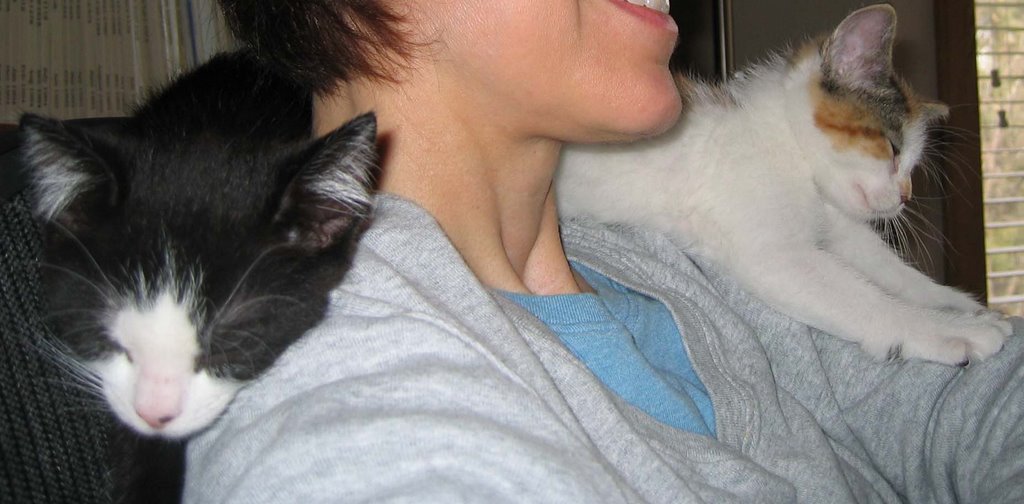
I'm sitting here acting primarily as a bed for kittens, so of course I find that quote at this minute to be resonating. But when did Colette say this, and upon what occasion? I recently listened to an audiobook recording of Claudine At School, and I can assure you it wasn't there. Don't you love life A.I., anno Internet? You have a question, you look up the answer. Unfortunately, all I've found so far is an interesting wikipedia entry (I didn't know all that) and a million websites listing cat quotations.
Questions 1 Inquiring Minds 0.

Thursday, November 02, 2006

Thought

In music, as with most things we try to do, failure is rarely caused by poor aptitude; the real culprit is a stunted imagination.

Frank R. Wilson
Tone Deaf and All Thumbs?

Monday, October 30, 2006

Thought

...it's not only our big dreams that shape reality....The small choices bear us irresistibly toward our destiny.

William James